St. Leo’s Church Hosts St. Patrick’s Day Dinner in Ava
The annual gathering celebrates a holiday steeped in history, legend and Irish tradition dating back more than 1,500 years.
Each March 17, people across the United States celebrate St. Patrick’s Day with green clothing, Irish-themed meals and festive gatherings. But the history behind the holiday is far older and more surprising than many realize.
St. Patrick, the man honored each year on March 17, was not actually Irish. Historians believe Patrick was born in Roman Britain around A.D. 385. As a teenager he was kidnapped by Irish raiders and taken to Ireland, where he spent several years working as a shepherd while enslaved.
After eventually escaping and returning home, Patrick later chose to return to Ireland as a Christian missionary. During the following decades he traveled across the island preaching and helping establish churches, becoming one of the most influential religious figures in Irish history.
Over time, legends surrounding Patrick grew. One of the most famous stories claims he drove snakes out of Ireland. Scientists say Ireland never had native snakes after the last Ice Age, and historians believe the tale may have symbolized Patrick’s role in pushing out pagan religious traditions.
Another well-known symbol of the holiday is the shamrock. According to tradition, Patrick used the three-leaf plant to explain the concept of the Holy Trinity. While historians cannot confirm the story, the shamrock eventually became a lasting symbol of both St. Patrick and Irish identity.
Today, green is closely associated with St. Patrick’s Day, but that was not always the case. Early depictions of Patrick were linked with blue, sometimes referred to as “St. Patrick’s Blue.” Green became the dominant color centuries later as Irish nationalism and the shamrock symbol gained popularity.
Although St. Patrick’s Day honors Ireland’s patron saint, many of the modern traditions surrounding the holiday developed in the United States. Some of the earliest recorded St. Patrick’s Day parades took place in American cities, including Boston in 1737 and New York in 1762.
Even the familiar meal of corned beef and cabbage has roots in Irish-American communities rather than Ireland itself. Historically, people in Ireland more commonly ate bacon and cabbage. Irish immigrants in the United States adopted corned beef because it was widely available and affordable.
For centuries the holiday remained primarily a religious feast day in Ireland. In fact, Irish law required pubs to close on March 17 until the 1970s. The festive public celebrations now associated with the holiday grew largely through Irish-American communities.
Locally, the tradition continues with a community celebration in Ava.
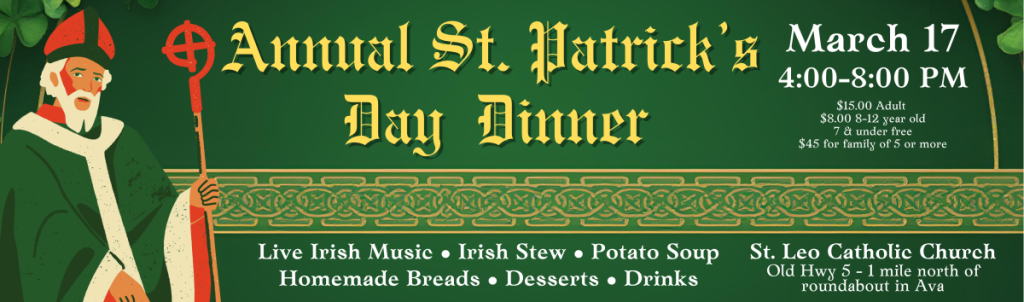
St. Leo Catholic Church will host its annual St. Patrick’s Day dinner on Tuesday, March 17, from 4 to 8 p.m. at the church, located one mile north of the roundabout on Old Highway 5.
The event will feature live traditional Irish music along with a menu that includes Irish stew, potato soup, homemade breads, desserts and drinks. Dinner prices are $15 for adults, $8 for children ages 8 to 12, and free for children age 7 and under. A family rate of $45 is available for groups of five or more.
Organizers say the event is open to everyone and provides an opportunity for the community to gather and celebrate a holiday that blends centuries-old religious tradition with modern cultural festivities.
While many people associate St. Patrick’s Day with shamrocks and parades, its history reaches back more than 1,500 years. From ancient missionary journeys to modern community dinners, the holiday continues to evolve while honoring the story behind Ireland’s most famous saint.